
Shenandoah VINE Has Two Layers
Virginia divides local-jail and state-prison notification work. Virginia Jail VINE through VINELink is the route for participating local facilities. That is the relevant layer while a person is held at RSW Regional Jail. RSW serves Shenandoah, Warren, and Rappahannock Counties from Front Royal, so a Shenandoah court case can appear under that regional jail.
NAAVI is the Virginia Department of Corrections notification service for state custody. VADOC says its registration is not connected to local Jail VINE. If RSW transfers a person to VADOC, the local subscription does not follow automatically. Register again in NAAVI after the state record becomes available.
| Custody path | Notification route | What to verify |
|---|---|---|
| RSW Regional Jail | Virginia Jail VINE / VINELink | Reported local custody, transfer, or release event |
| VADOC prison or supervision | NAAVI and VADOC records | State status, advanced notice, actual release |
| Federal Bureau of Prisons | BOP locator and federal records | Federal custody and release date |
| ICE detention | ICE locator and ERO | Civil immigration custody or transfer |
A local-jail release can instead be a transfer to VADOC, another jail, USMS, or ICE. VINE’s event label must be checked against the RSW release transaction when destination matters.
Search a Shenandoah Inmate on VINELink
Search for one identified adult. Gather the exact name, an identifier when known, and the expected custodial agency. A common name can produce several results. A missing result may mean a spelling mismatch, reporting delay, transfer, release, nonparticipating custody, or a record outside public display.
- Open the Virginia VINELink login and search and choose the person or offender search.
- Enter the person’s name and an available identifier. Narrow the result instead of selecting the first similar name.
- Open the candidate record. Compare the custodial agency, location, status, and identifiers with the known Shenandoah case.
- Copy the status wording exactly. Interface labels can change, and “released” should not be rewritten as an unconditional community discharge.
- Call RSW Booking or request the release record when exact time, reason, and destination are needed.
The official Virginia VINELink search source appears below as a visual reference for the state entry point.
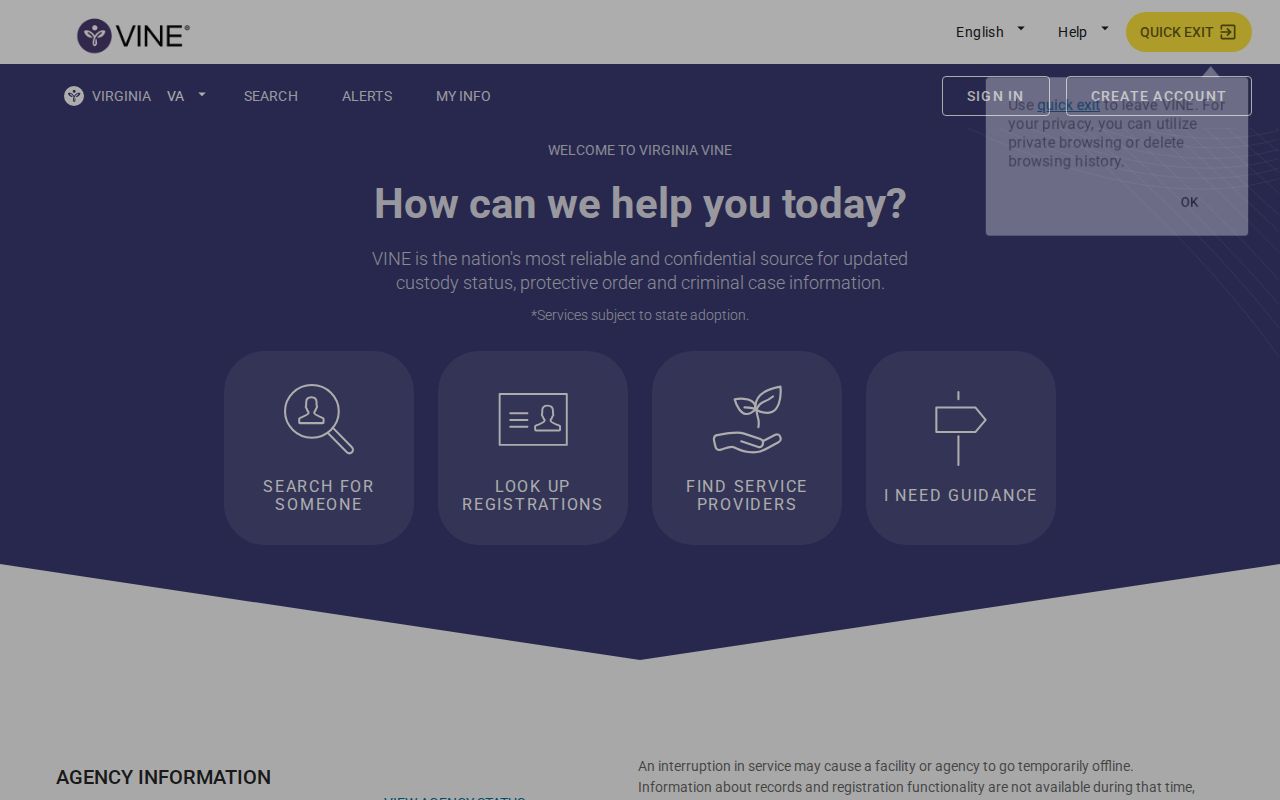
The search result is an agency report, not the jail’s signed release sheet. Identity and destination still need direct confirmation.
For a wider person-finding sequence that also uses court and records channels, use the Shenandoah County released inmate search. VINELink is narrower: it checks one participating record and manages notifications.
Shenandoah VINE Release Fields
A matching VINE record can display custody facts supplied by the participating agency. The precise labels vary with the interface and record. Read what is present. Do not add a projected date or release reason that the record does not show.
| Field | How to read it |
|---|---|
| Name and identifier | Use both to reduce the risk of a same-name mismatch. |
| Custodial agency | Shows which participating jail reported the event. |
| Location | May identify RSW or another reported holding location. |
| Custody status | Reflects the agency event at the time of its data update. |
| Notification options | Shows channels currently offered for that record. |
A changed or released status means the source agency sent a custody event. It does not show every legal effect. For instance, “release” from RSW may coincide with immediate transfer into state or immigration custody. Court disposition supplies legal context, while RSW Records supplies the local transaction and destination.
Important: VINELink is not a certified release record. Data flow, participation, matching, and transfer timing can affect what appears.
Register Shenandoah Release Notifications
Register on the matching person record, not on a general state page alone. Offered channels may include telephone, text, or email. Enter contact information with care. A wrong digit can defeat the alert, and the telephone PIN has a distinct purpose from the person’s booking or inmate number.
- Select “Get Notified” or “Register for Notifications” on the matched record.
- Choose an offered delivery channel and language. Enter the telephone number, text number, or email address accurately.
- Create or sign in to an account if prompted, or use the available guest flow.
- For a telephone alert, create the requested four-digit PIN. Never use the inmate number as the PIN.
- Complete the confirmation or verification prompt and save the registration details privately.
- If custody moves from RSW to VADOC, complete a new NAAVI registration for the state record.
The VINELink registration workflow is represented by the matched capture below.
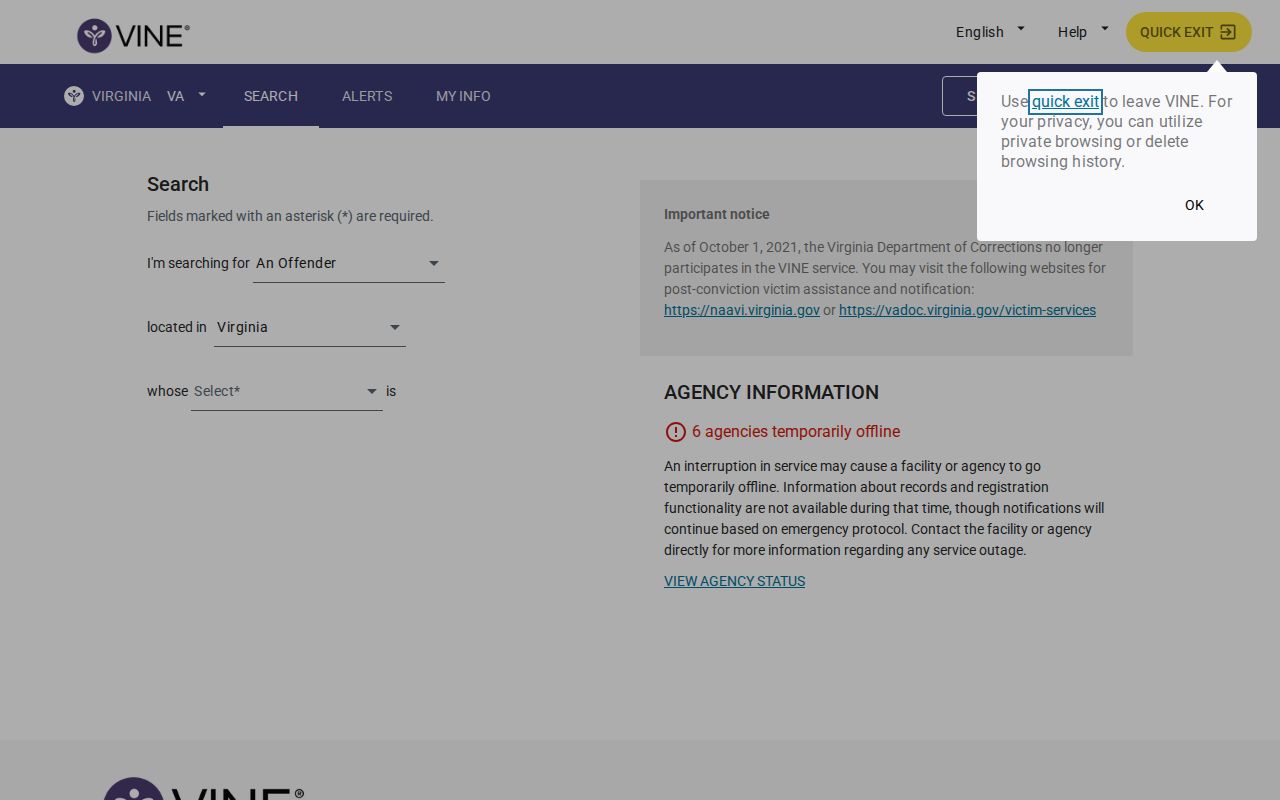
The registration panel supports future alerts. It does not certify that a later event happened exactly when a phone or email arrived.
Keep the confirmation details. If an alert does not arrive, check the record and contact the holding agency rather than assuming custody did not change. Registration errors, agency timing, and delivery problems can all affect a message.
Shenandoah Transfers Require NAAVI
A person sentenced in Shenandoah County can leave RSW for VADOC intake. That event ends RSW custody but does not end incarceration. After intake, the VADOC Inmate and Supervisee Locator becomes the right status tool, and NAAVI becomes the notification path.
VADOC’s victim-notification page distinguishes its local and state layers. An advanced-release notice is an anticipated state release, generally sent around 30 days before the expected date. A release-date notice means the person is no longer in VADOC custody and notifications then end. A future notice can change as the date changes.
The matched official VADOC notification source shows that separation.
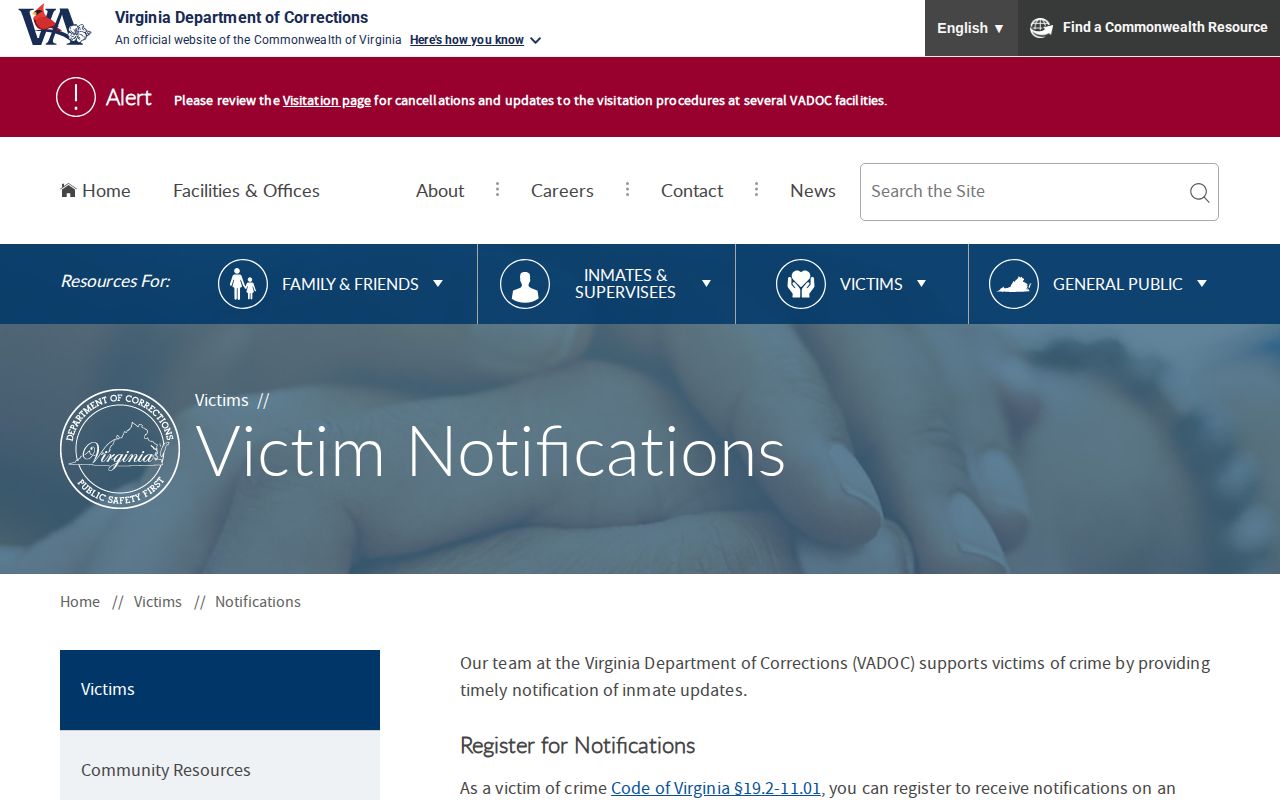
This state layer explains why two registrations are required when a Shenandoah County case moves from RSW to VADOC.
Note: Record the exact custodian before registering, because local VINE and state NAAVI subscriptions are not interchangeable.
Confirm a Shenandoah VINE Alert
Preserve the event label, time received, and reporting agency. Then contact the authority that held the person. For RSW, Booking can address present custody, while Records can provide an existing release transaction. The RSW main address is 6601 Winchester Road, Front Royal, VA 22630. The main number is 540-622-6097, Booking is 540-622-8620 or 540-622-8683, and Records is 540-622-5024.
Ask whether the person remained in custody, left for the community, or transferred. If transferred, request the destination. A court docket can show bond, dismissal, time served, sentencing, or another order, yet the docket may not prove the hour jail processing ended. Exact proof comes from the custodial record.
For a VADOC event, compare the locator status and obtain the signed Order of Release, Conditions of Probation, or Conditions of Parole when that proof is needed. For federal custody, use the BOP locator. For immigration custody, use ICE. Neither VINE nor NAAVI is a universal locator.
Keep the VINE message beside the later agency response. The message records what the notification network reported and when it arrived. The RSW transaction records when regional-jail custody ended, why it ended, and any destination entered by staff. If those times differ, label both rather than choosing one without support. A delayed alert does not change the jail’s recorded release time, and an early court order does not prove that release processing had finished.
Shenandoah VINE Search Limits
Every database is a snapshot. VINE depends on participating-agency reports, while RSW JailTracker and court records have their own update cycles. Release processing, a transfer, data correction, or sealing can change a result. Search with exact identifiers and note the time of access.
Names alone are weak. Suffixes, aliases, hyphenation, middle names, and transcription can produce false matches or false absences. When permitted, compare date of birth, booking number, VADOC ID, case number, and agency. Do not announce a release based on a same-name result.
Federal prisoners are outside Virginia VINE and NAAVI. A person can also leave RSW under a USMS or ICE transfer without entering VADOC. Use the destination on the release record to choose the next system.
A court docket is another cross-check, but it has a defined limit. A Shenandoah judge may enter bond, sentence, dismissal, or another order before jail staff complete the physical move. Compare the case number and disposition with the RSW event. If VINE reports release while the docket remains pending, both records can be accurate because release on bond does not close the case.
When VINE sends a release message, ask RSW whether it was community release or agency transfer. Request the date and time, release authority, and recorded destination if exact proof is needed. If the destination is VADOC, wait for intake and then use the state locator and NAAVI. If the destination is another county, federal authority, or ICE, follow that receiving custodian instead.
Sealing can also change what is public. Do not reconstruct an unavailable Shenandoah record from cached pages or stale mirrors. An official limitation is part of the result and should be respected. The sound report states the service, event wording, and time checked, then identifies what the custodial agency later confirmed.
Notification channel and legal status are separate facts. A text or email can help a family plan contact or transportation, but the message cannot answer every case question. The court explains why release was authorized. RSW explains when its custody ended and where the person went. VADOC explains a state transfer or later discharge. Keeping those roles distinct prevents a local alert from being mistaken for the end of all custody.
Check saved registrations after a phone number or email address changes. The four-digit telephone PIN confirms receipt and helps manage calls; it is not a public identifier and should remain private. If the record no longer offers an alert, contact the agency for the current official route.