
Shenandoah Projected and Actual Release
A projected date is the custodial authority’s present calculation. An actual date records an event that occurred. The first can move. The second should be supported by a release transaction, signed release document, or agency discharge entry. A court sentence supplies the legal term and credit orders, but RSW or VADOC performs the time computation for the sentence under its control.
Pretrial custody is different. Bond may authorize release once conditions are met, but it does not prove bond was posted, another hold cleared, or processing finished. A docket line that says “time served” can also coexist with another case or detainer. Confirm physical departure and destination with the jail.
Scheduled vs. actual release: A future date is not proof of release. Confirm the completed event with the custodian’s signed or transactional record.
- Projected release date
- A current calculation that remains subject to credits, orders, holds, and corrections.
- Actual release date
- The recorded date custody ended for that agency.
- Detainer
- A request or authority that can cause transfer to another custodian instead of community release.
- Jail credit
- Credit applied for qualifying time already spent confined.
Find a Shenandoah Projected Date
Use official identity details and preserve the exact on-screen label. VADOC’s current public tool is the Inmate and Supervisee Locator. It covers people in state institutions, VADOC-supervised probationers and parolees, institutional hospitals, some people in local or regional jails under state authority, and CCAP participants.
- Decide whether the person is pretrial, serving a local term at RSW, or serving a state-responsible sentence.
- For VADOC, open the Inmate and Supervisee Locator. Search with the first three letters of the first name plus full last name, or a seven-digit DOC ID, using optional filters as needed.
- Compare identity, current location, custody or supervision status, and each date label. Do not turn a parole-eligibility or good-time field into an actual release.
- For a local RSW term, call Booking or Records and ask for the current date calculation and any existing release record. Compare the Shenandoah sentencing docket.
- If the sources differ, quote each label to the agency. Ask whether a new order, jail credit, detainer, or correction changed the calculation.
- After the date passes, obtain the actual RSW transaction or VADOC signed release document.
VADOC states that the locator updates daily and warns that information may be wrong or out of date. Record the access date. A missing result may reflect local-only custody, intake delay, an inactive record, spelling, or display limits.
The official VADOC time-computation source is shown below for the state process.
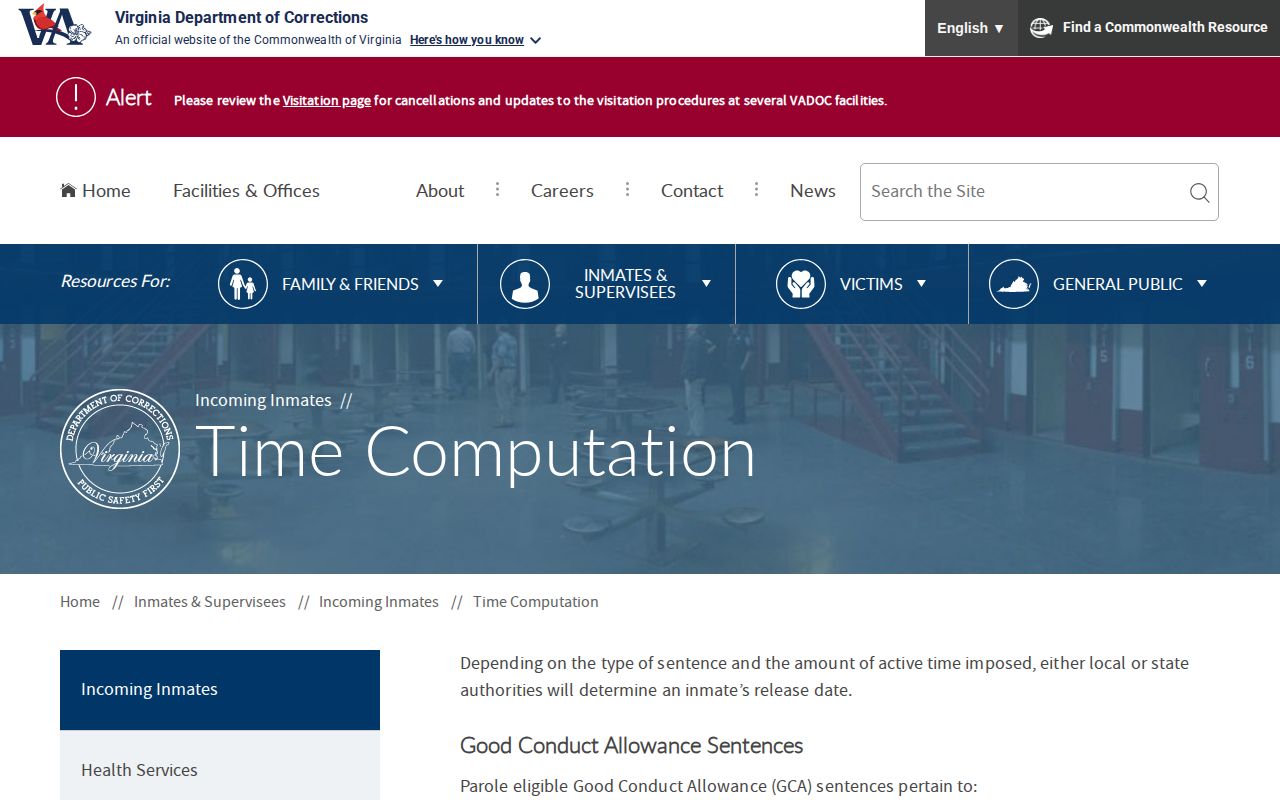
The agency’s calculation, not a reader’s estimate from a sentence, controls the state projected date.
Virginia Credits Change Shenandoah Dates
Modern earned sentence credits apply to many felony offenses committed on or after January 1, 1995. Virginia Code § 53.1-202.3 limits listed serious offenses to no more than 4.5 credits for each 30 days served. Eligible other offenses use a tiered system that can reach 15 credits per 30 days at Level I, subject to classification, program participation, cooperation, and conduct.
VADOC describes the post-1995 truth-in-sentencing framework as generally requiring at least 85 percent for covered felonies. That figure is not a universal calculator. Offense category, offense date, statutory amendments, enhanced-credit eligibility, classification, and mixed sentences can change the result. Section 53.1-202.2 defines a credit as a one-day deduction, while § 53.1-189 addresses forfeiture and restoration.
Older Good Conduct Allowance rules can govern parole-eligible felony offenses committed before January 1, 1995 and certain older misdemeanors. VADOC describes class-based earnings from zero to 30 days per 30 days served. Section 53.1-187 deals with credit for confinement while awaiting trial. Consecutive terms, concurrent terms, probation violations, and several credit systems make do-it-yourself math unreliable.
The matched earned sentence credit statute appears below.
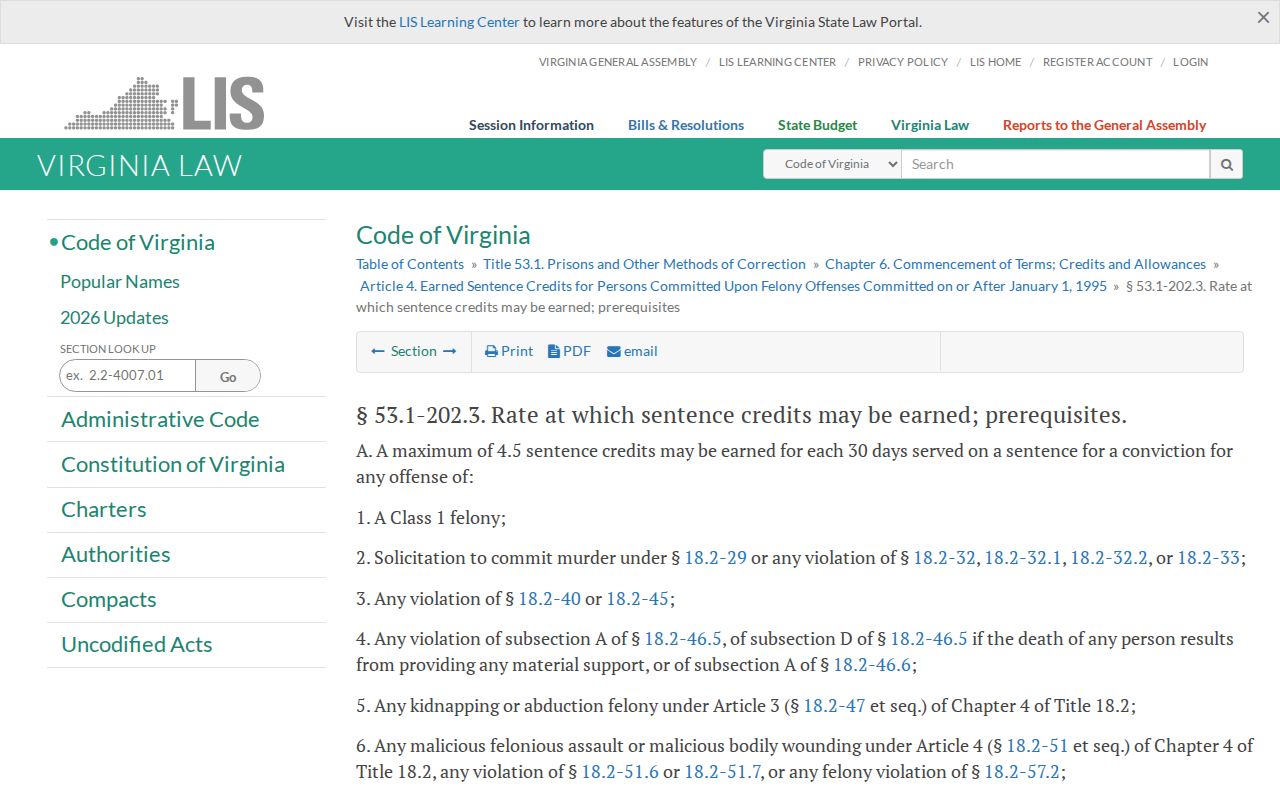
The statute identifies the legal framework, while VADOC applies the person-specific sentence and classification data.
Note: Use the current agency computation because the 85-percent shorthand does not resolve exceptions, older terms, or enhanced-credit eligibility.
Why Shenandoah Release Dates Move
VADOC reviews electronic and paper records, warrants and detainers, court orders, disciplinary matters, uncalculated sentences, and civil holds. A change may alter the date itself or only the destination. For example, a detainer can leave a sentence-end date in place while directing the person to another custodian.
| Factor | Possible effect | Best check |
|---|---|---|
| New or amended court order | Changes the controlling term or credit | Certified docket and agency recalculation |
| Jail-credit correction | Moves the computed date | Commitment order and time record |
| Credit-class change | Changes future earning rate | Current VADOC calculation |
| Forfeiture or restoration | Subtracts or returns earned credit | VADOC record |
| Consecutive sentence | Adds active time in sequence | Court orders and time computation |
| Detainer or civil hold | May change destination, not the date | Release record naming receiving agency |
| Parole action | Starts more review and release processing | Board action plus VADOC actual status |
Do not describe a correction as misconduct unless the record says so. Administrative review can fix a clerical or credit error without any disciplinary event.
Read Shenandoah Date Scenarios
If a VADOC result shows a future date, copy its exact label and the date viewed. Explain that credits, forfeiture or restoration, court changes, detainers, and corrections can move it. Use state notification for advance planning. Afterward, verify status and request signed release documents.
If the court grants bond, the order authorizes release only after its conditions and all other holds are resolved. RSW supplies the physical event. If a docket says “time served,” ask whether another case or warrant changed the destination. A single docket entry cannot prove that the person walked out.
If the Parole Board reports a grant, continue to the VADOC locator. Certification, plan development, conditions, notice, detainers, and processing may remain. Do not call the Board’s decision date a release date. The distinction between a future projection and an accomplished event is essential.
If no official system shows the person, recheck spelling, aliases, date of birth, case locality, and the custodian. A local-only sentence, old record, transfer, intake lag, or sealed matter can explain the gap. A narrow records request is stronger than guesswork.
Release time and release date may also differ among records. A court can sign an order, jail staff can finish processing later, VINE can send a notice after the event, and a public database can refresh on its own cycle. Report the source with the event: “court ordered,” “RSW recorded,” “VINE notified,” or “VADOC updated.” Those phrases are more precise than presenting the first timestamp found as the one true release time.
A transfer scenario needs the same care. If RSW records a sentence as complete but lists a receiving agency, the local term may have ended while custody continued. The projected date was not necessarily wrong. The destination changed the practical outcome. Follow the receiving agency’s locator and request its later release record.
Identity controls matter throughout the date search. Match the booking number, VADOC ID, case number, and date of birth when those facts are lawfully public. Hyphenated names, suffixes, aliases, and transcription errors can cause false matches. A date tied only to a similar name should never be presented as the Shenandoah person’s release date.
Confirm a Shenandoah Actual Release
For RSW, request the existing release date and time, release type or authority, and destination. Records is at 6601 Winchester Road, Front Royal, VA 22630, with telephone 540-622-5024. Booking is 540-622-8620 or 540-622-8683. The main line is 540-622-6097.
For VADOC, the strongest later record is the signed release document. VADOC describes an Order of Release and, when applicable, Conditions of Probation or Conditions of Parole. Its facility-release process records the discharge date and says release occurs by 11:59 p.m. on the date, weather permitting.
The official VADOC facility-release source shows the documents and release-day process.
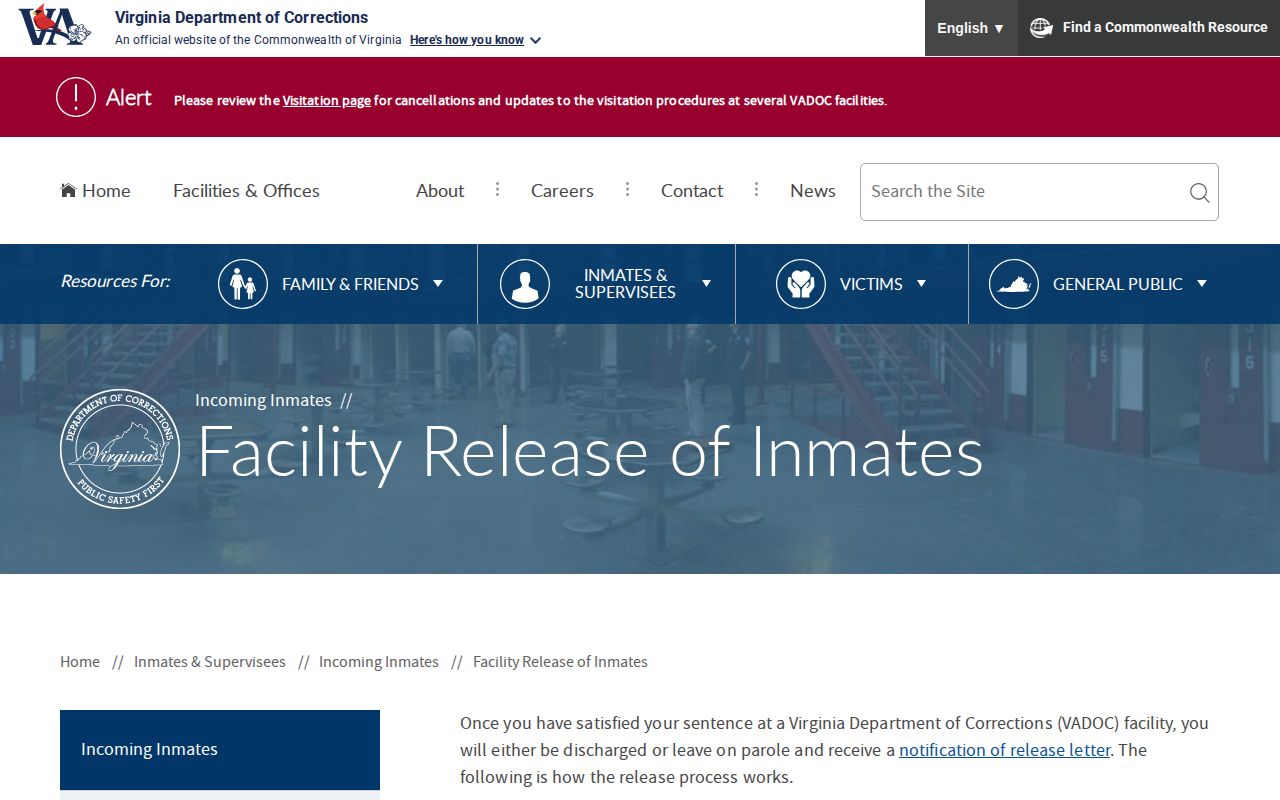
Those signed documents distinguish an accomplished discharge or parole release from an earlier projected date.
For prospective alerts, the Shenandoah County VINE inmate check explains local Jail VINE and the separate state NAAVI layer. Notifications still require confirmation with the custodian.
Keep copies of the projection, later status, and signed release material together. That sequence shows what was expected, what changed, and what actually happened. If a detainer caused transfer, add the receiving agency’s record rather than calling the RSW or VADOC date a community release. When a field is unclear, ask the source agency to define its own label before drawing a conclusion.