
Shenandoah Parole and Probation
A person can live in Shenandoah County and still be supervised by the Virginia Department of Corrections. VADOC Community Corrections supervises qualifying parolees, probationers, and some other people outside prison. The source of that authority matters. A court creates probation through a sentencing or revocation order. The Virginia Parole Board decides discretionary parole for a person who is legally eligible, while VADOC calculates time, completes release processing, and provides field supervision.
Neither label means the criminal record vanished. Both can impose rules and reporting duties. Yet they begin in different ways and end through different official acts. The comparison below keeps those records separate.
| Point | Parole | Probation |
|---|---|---|
| Legal source | A conditional release decision under Virginia parole law | A sentence or supervision order entered by a court |
| Key public record | Parole Board action, then VADOC release and supervision status | Sentencing docket, conditions, and VADOC supervision record |
| Physical custody | Usually follows release from incarceration | May follow active time or be ordered without a prison release |
| End point | Official discharge or expiration under the responsible authority | Court or VADOC record showing completion or discharge |
- Parole
- Conditional release from incarceration before the full term ends, when Virginia law permits it.
- Probation
- Court-ordered supervision in the community, often tied to suspended time.
- Discharge
- The official end of the relevant custody or supervision term.
- Absconder
- A person alleged to have stopped required contact or compliance. It is not a new conviction by itself.
Verify Shenandoah Post-Release Supervision
Begin with the record that created the supervision. For probation, use the Shenandoah court docket and read the sentencing entries, suspended time, and any later revocation. General District Court handles adult misdemeanors and preliminary felony stages. Circuit Court handles felony trials and appeals. For parole, start with the official Board material, but do not treat a favorable vote as proof that release happened that day.
- Confirm the person’s full name, date of birth when lawfully available, and case or VADOC number. Name-only matches are weak.
- Read the Shenandoah court docket for probation, suspended time, revocation, or a release-related order.
- For parole, check the Virginia Parole Board reports archive for the relevant month and copy the action exactly.
- Use the VADOC Inmate and Supervisee Locator to compare custody, supervision, and office information.
- Contact District 11 with exact identity details and ask which public facts it can confirm. Do not seek private reporting schedules.
- When the physical release date matters, obtain the VADOC release document or the RSW release transaction instead of relying on a vote or docket line.
A released person may disappear from the RSW live roster but remain under state supervision. The reverse also occurs: someone on local probation may never have entered VADOC prison custody. The complete Shenandoah County release search and jail-record path are available on the home page.
Important: A court order, parole action, and physical release are separate events. Confirm each event with the agency that controls it.
Shenandoah Supervision Through District 11
The local state route is VADOC District 11 in Winchester. Its directory says the district serves Shenandoah County and lists added offices in Front Royal and Woodstock. The main listing is the sound starting point because staff and satellite arrangements can change. Exact reporting details are person-specific and may be restricted for privacy or safety.
Virginia Department of Corrections, District 11100 Premier Place
Winchester, VA 22602
540-722-3404
VADOC facilities and offices directory
The office can route a public supervision question, but it does not replace the sentencing court or Parole Board. Ask narrowly whether the record reflects active supervision and which district holds the file. A private appointment time, residence detail, treatment record, or case plan should not be inferred from a public listing.
The Virginia Court Case Information portal supplies the judicial side. Read the locality and case number closely. A probation-revocation entry can show that the court addressed alleged noncompliance, though it does not by itself establish the current field status.
Shenandoah Parole Board Records
The Virginia Parole Board reviews people who remain eligible for discretionary parole under state law. Its official process description covers interview, record review, evaluation, decision, reasons, plan development, and notice. The Board decides parole. VADOC houses the person, computes the term, completes the release steps, and later supervises the parolee.
The public meetings page describes video meetings used since July 1, 2024 when the Board is inclined to grant discretionary parole or geriatric conditional release. An agenda is posted at least three working days before a meeting. It lists people to be heard, a stream, and dated minutes. That page is not a calendar of every routine review. A missing name therefore does not prove denial or lack of eligibility.
The monthly reports may show a grant, denial, deferral, or another Board action. A grant can still be followed by plan review, conditions, notice, a detainer, and release processing. Search the VADOC record after a favorable result. Record the actual displayed status and date rather than converting the Board date into a release date.
The matched Virginia Parole Board source is shown below so the agency roles can be checked at their origin.
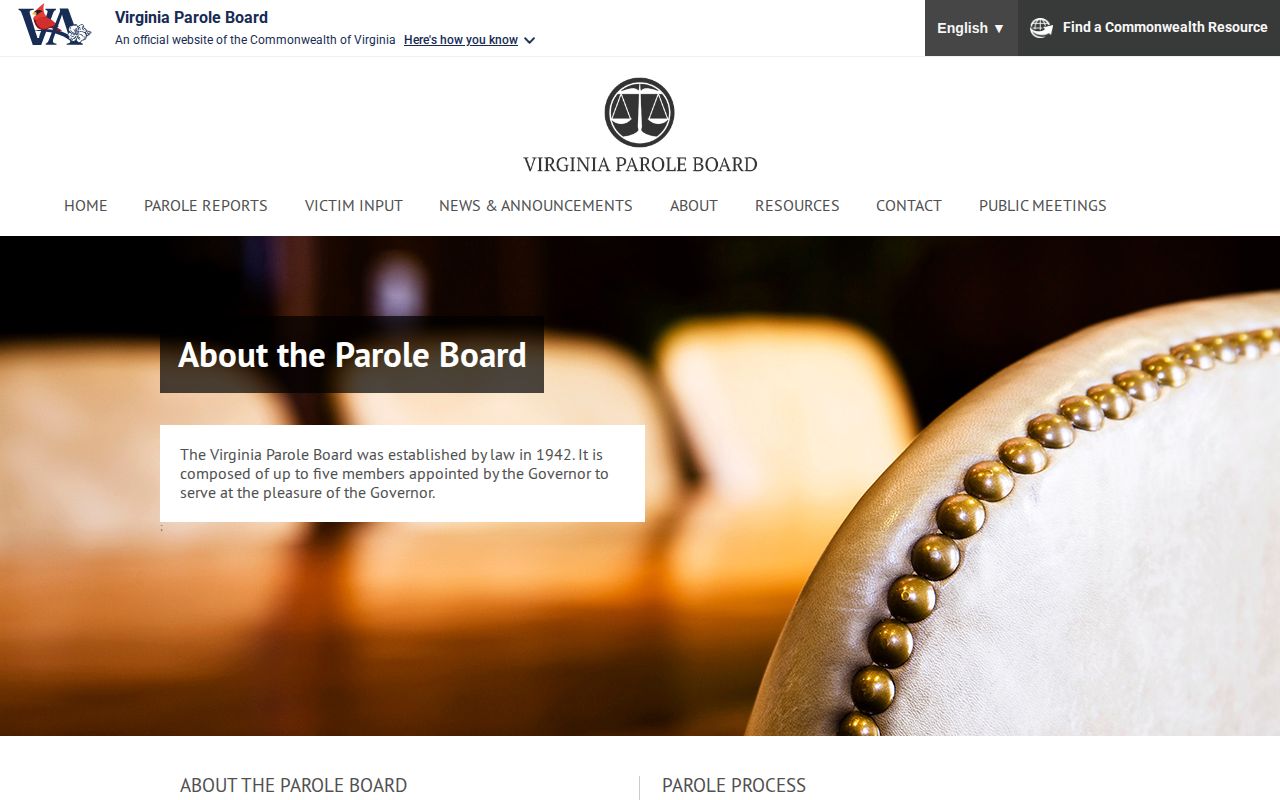
The Board page supports the decision path, while the VADOC record remains necessary to confirm actual release and supervision.
Shenandoah Parole Eligibility Records
Virginia parole eligibility cannot be found by dividing a sentence into a simple fraction without first identifying the governing law. Virginia Code § 53.1-151 contains the progression for covered parole-eligible terms and special rules. Section 53.1-165.1 generally abolished discretionary parole for felonies committed on or after January 1, 1995, yet exceptions and later changes require a person-specific review.
Offense date, prior commitments, sentence type, and an applicable exception all matter. The Board determines its jurisdiction. VADOC computes dates. Court records identify the conviction and sentence. If those sources appear to conflict, quote each label and ask the responsible agency to resolve the difference. Do not promise eligibility from a sentence length alone.
Probation has a different path. The judge’s order controls its term and conditions, subject to later modification or revocation. A parole statute should not be used to calculate a probation end date.
Shenandoah Supervision Violations
Common supervision conditions can concern reporting, travel, contact, treatment, fees, and compliance with laws, but the signed order governs each person. A claimed violation is not the same as a proven violation. VADOC may investigate and the court or other authorized body may decide the legal result, depending on the supervision type.
An absconder label means alleged failure to remain in contact or comply. It does not establish a new conviction. A public locator can also lag. Confirm any warrant with the issuing court or law-enforcement authority, and confirm supervision status with District 11. Do not infer a warrant from a missed public entry.
Supervision can end through completion, expiration, a formal discharge, or another authorized action. Keep the completion record. An old docket line stating probation was ordered does not prove that it remains active years later. Likewise, release from prison does not prove that parole or probation has ended.
Note: Exact conditions and reporting schedules belong to the supervisee and responsible agency, not to a public name-search inference.
Shenandoah Release and Reentry Support
Northwestern Community Services Board has documented jail-services discharge planning for RSW Regional Jail. That gives a person preparing to leave a local jail a practical referral question: ask RSW staff whether a discharge planner or community-services contact is available. The source does not promise eligibility, placement, or a specific result.
RSW also operates Work Force and home electronic monitoring through Community Custody. Those placements are not parole. Home electronic monitoring uses GPS and remains an administered custody arrangement. A person outside the secure building may therefore still be serving a local sentence rather than completing discharge or entering VADOC parole.
This distinction prevents a common error. Ask which authority controls the placement, what order authorized it, and whether the status is community custody, pretrial supervision, probation, or parole. The label determines the right office and record.
Mail After a Shenandoah Release
RSW has a rare post-release route for a former inmate’s own scanned personal mail. The RSW mail policy says the former inmate may email inmate.mail@rswregionaljail.com with the facility name, full name, inmate ID, and email address. After verification, RSW sends a download link.
This process concerns the former inmate retrieving their own mail. It is not a public records search and does not confirm parole or probation. Still, it can matter when release documents, identity papers, or personal correspondence remain in the scanned-mail system. Use the exact identity details requested by RSW and keep the download private.